
What Are Peptides? A Complete Introduction for Institutional Researchers
Peptides are short chains of amino acids linked together by peptide bonds. They sit at the midpoint of biological complexity — larger and more structured than a single amino acid, but smaller and simpler than a full protein. For anyone working in peptide research UK settings, this basic definition is the foundation for everything downstream: mechanism of action, purity verification, storage, and regulatory handling.

Table of Contents
- The Basic Chemistry
- Peptides vs. Amino Acids vs. Proteins
- Classification by Size
- Classification by Origin
- Purity and Identity Verification
- Regulatory and Legal Status in the UK
- Why Peptide Size Matters for Research
- What This Article Doesn’t Cover
- FAQs
The Basic Chemistry
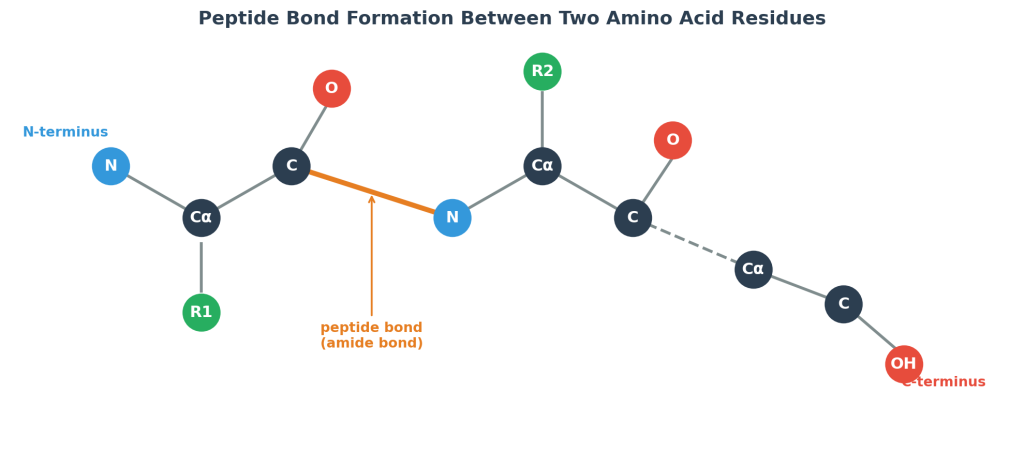
Amino acids are the building blocks of both peptides and proteins. When two amino acids join, the carboxyl group (-COOH) of one reacts with the amino group (-NH2) of another, releasing a water molecule and forming a peptide bond (also called an amide bond). Chain this reaction together and you get a peptide — a linear sequence of amino acid “residues” held together by these bonds.
The resulting molecule has:
- An N-terminus (the free amino group end)
- A C-terminus (the free carboxyl group end)
- A backbone of repeating peptide bonds
- Side chains (R-groups) hanging off each residue, which determine the peptide’s chemical properties — polarity, charge, and how it folds or stays flexible
Peptides vs. Amino Acids vs. Proteins
This distinction trips people up constantly in peptides UK research contexts, so it’s worth being precise:
| Molecule | Typical Size | Structure | Example |
|---|---|---|---|
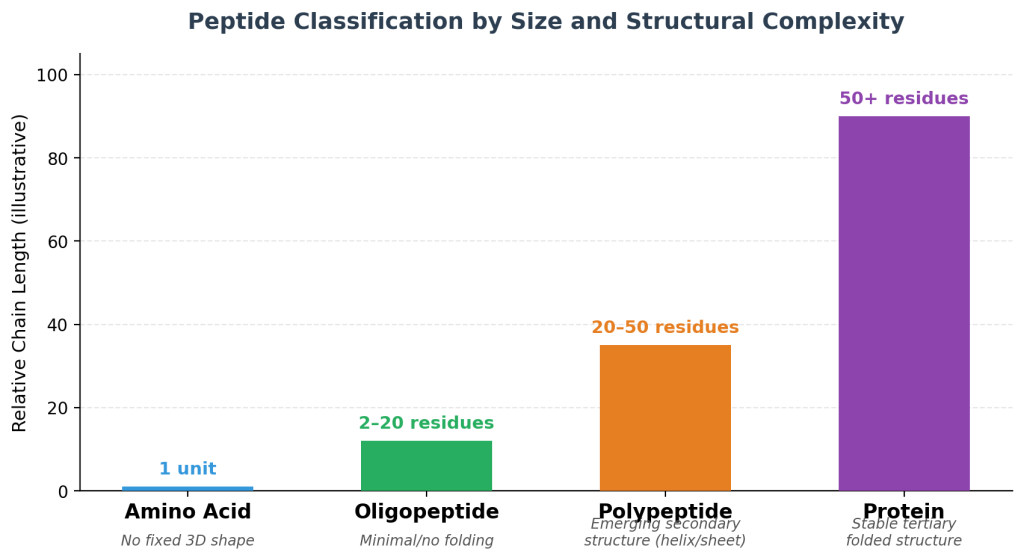
| Amino acid | 1 unit | A single building block | Glycine |
| Oligopeptide | 2–20 amino acids | Short chain, minimal fixed 3D shape | A dipeptide or tripeptide motif |
| Polypeptide | 20–50 amino acids | Beginning to show secondary structure | Alpha helix fragments |
| Protein | 50+ amino acids | Long chains folding into stable, complex 3D structures | Enzymes, antibodies |
The cutoff between “peptide” and “protein” is not a strict scientific law — it’s a convention. Some sources place the line at 50 residues, others at a molecular weight threshold (commonly ~10 kDa). What matters more than the exact number is behaviour: peptides tend to be structurally flexible and often lack the stable tertiary folding that defines proteins.
Classification by Size
Researchers commonly group peptides as follows:
Oligopeptides
Short chains of roughly 2–20 amino acids. Dipeptides (2 residues) and tripeptides (3 residues) fall in this category. These are often used to study minimal structural motifs required for biological activity.
Polypeptides
Longer chains, typically 20–50 amino acids, beginning to show some secondary structure (such as alpha helices or beta sheets) but not the full folded complexity of a protein.
Macrocyclic and Cyclic Peptides
Peptides whose backbone forms a closed ring rather than a linear chain. Cyclisation often improves stability and resistance to enzymatic degradation, which is why cyclic peptides are of particular interest in stability-focused research.
Classification by Origin
Peptides used in research are typically categorised by how they were produced:
| Origin | Description | Common Research Use |
|---|---|---|
| Natural | Isolated or derived from biological sources | Studying endogenous signalling peptides |
| Synthetic | Chemically manufactured via solid-phase peptide synthesis (SPPS) | Precise sequence and purity control |
| Recombinant | Produced using engineered organisms (bacteria/yeast) expressing an inserted DNA sequence | Larger-scale peptide/protein production |
Nearly all peptides supplied for laboratory research today are synthetic, produced to a specified purity and verified with a Certificate of Analysis (CoA).
Purity and Identity Verification
For any institutional buyer sourcing research peptides, the CoA is the single most important document accompanying a batch. A credible CoA typically includes:
- HPLC (High-Performance Liquid Chromatography) data confirming purity, ideally ≥98%
- Mass spectrometry (MS) data confirming molecular identity matches the labelled sequence
- Endotoxin testing (commonly LAL — Limulus Amebocyte Lysate) confirming the absence of bacterial endotoxins for cell-based or in-vivo research
- Lot number, synthesis date, and storage recommendations
Reputable suppliers issue CoAs from ISO 17025-accredited third-party laboratories rather than relying solely on in-house testing — this distinction matters when auditing a supplier for institutional procurement.
Regulatory and Legal Status in the UK
This section is written for institutional and laboratory use — it is not guidance on personal or human use.
In the UK, research peptides such as BPC-157, TB-500, and similar compounds occupy a specific regulatory position that researchers should understand precisely before procurement:
- Not licensed medicines. The MHRA (Medicines and Healthcare products Regulatory Agency) has not granted marketing authorisation for these compounds as medicines, meaning they have not undergone the MHRA’s testing and approval pathway for safety, quality, and efficacy in humans<cite index=”4-1″>.</cite>
- Not controlled substances. Compounds like BPC-157 are not scheduled under the Misuse of Drugs Act 1971, so they do not carry the same legal restrictions as controlled drugs<cite index=”6-1″>.</cite>
- Lawful for research procurement, not for human administration. These peptides can be lawfully supplied and held for laboratory and investigational research use; they may not lawfully be marketed, advertised, or supplied for personal use, weight loss, performance enhancement, or any therapeutic purpose outside an authorised clinical or veterinary trial<cite index=”5-1″>.</cite>
- Institutional recordkeeping expectations. Good practice for institutional holders includes logging lot numbers, CoAs, and storage conditions in an inventory consistent with the host institution’s chemical hygiene plan, and retaining import/shipping documentation<cite index=”5-1″>.</cite>
- Cross-border and import considerations. Rules vary by jurisdiction — Health Canada, for example, classifies BPC-157 as a prescription drug when intended for human use, and the EU has not conducted an EMA-level review, leaving individual member states to apply their own rules<cite index=”4-1″>.</cite> Import compliance should be verified for each shipment rather than assumed.
- MHRA position on human use. The MHRA has actively cautioned against sourcing unlicensed medicines outside regulated channels, since such products bypass standard safety and quality checks<cite index=”7-1″>.</cite>
For a working definition: a product correctly labelled “for laboratory/research use only, not for human or veterinary use” is being supplied within this framework. Any product or listing that implies suitability for self-administration, dosing, or therapeutic use falls outside it.
(See also our Peptide Research UK pillar guide for a full regulatory overview across the compound categories we stock, and our Research Compound Category Page for current CoA documentation by batch.)
Why Peptide Size Matters for Research
The relatively small size of peptides compared to proteins gives them several properties that make them valuable research tools:
- Easier to synthesise reproducibly — shorter chains mean fewer synthesis steps and fewer opportunities for error
- More tractable structurally — smaller molecules are easier to model, characterise, and modify
- High target specificity — peptides can be designed to interact with a specific receptor or binding site with much greater selectivity than small-molecule compounds
- Biological relevance — many peptides mimic or block naturally occurring signalling molecules, making them useful probes for studying cellular pathways in areas such as tissue-repair research or dermal signalling (relevant to what are peptides for skin research models)
What This Article Doesn’t Cover
In the interest of staying strictly within a research-and-compliance scope, this article deliberately does not include:
- Purchasing guidance, vendor comparisons, or “best supplier” rankings
- Dosing, administration routes, or injection technique — these are outside the scope of research-use content and are relevant only within an authorised clinical or veterinary trial setting
- Bodybuilding or performance-enhancement protocols
Researchers evaluating suppliers should assess CoA quality, ISO accreditation, and documentation practices rather than price or marketing claims alone.
FAQs about Peptides?
What are peptides, in simple terms? Peptides are short chains of amino acids joined by peptide bonds — smaller and more flexible than proteins, but built from the same basic units.
What’s the difference between a peptide and a protein? Size and structure. Peptides are generally under ~50 amino acids and often lack a fixed 3D fold; proteins are longer and fold into stable, complex structures. The exact cutoff is a convention, not a hard rule.
Are peptides legal in the UK? Most research peptides are not classified as controlled substances under the Misuse of Drugs Act, but they are also not licensed medicines. That means they can be lawfully supplied and held for laboratory research, but not marketed or supplied for human use<cite index=”4-1,6-1″>.</cite> Legal status can differ by specific compound, so it should be checked individually rather than assumed across the category.
Is BPC-157 legal in the UK? BPC-157 is not a controlled drug under the Misuse of Drugs Act 1971, but it is also not an MHRA-licensed medicine, so it cannot be legally sold, marketed, or supplied for human use — only for research purposes<cite index=”6-1″>.</cite>
What are peptides used for in bodybuilding research? Some peptides are studied in preclinical and early research settings for their potential effects on tissue repair, recovery signalling, and growth-hormone-axis pathways. This is an active research area, but it is distinct from — and should not be confused with — human self-administration, which sits outside the licensed-medicine framework described above.
What are peptides for skin? In cosmetic science research, certain short peptide sequences (e.g., signal peptides, carrier peptides) are studied for their interaction with skin-cell signalling pathways relevant to collagen synthesis and barrier function. This is a distinct research category from injectable therapeutic peptides and follows separate cosmetic-ingredient regulatory pathways.
How is peptide purity verified? Primarily through HPLC (for purity percentage) and mass spectrometry (for identity confirmation), summarised in a Certificate of Analysis. Endotoxin testing is added for cell-based or in-vivo research applications.
Where can I read more about how peptides work biologically? See our companion article, How Peptides Work, which covers receptor binding, signal transduction, and mechanism of action.
Sources cited for the legal section: MHRA unlicensed-medicine classification, Misuse of Drugs Act 1971 scheduling status, and cross-jurisdictional comparison — drawn from current regulatory-guide sources checked in July 2026.