
How Do Peptides Work? Receptor Binding and Cellular Signalling Explained
Peptides don’t act like drugs that flood a system and produce a blunt effect. Most function as signalling molecules — precise biochemical messages that bind to specific targets on or inside a cell and trigger a defined chain of downstream events. Understanding this signalling logic is essential for interpreting peptide research literature and designing sound experimental protocols, and it’s the most direct answer to the question researchers and students alike start with: how do peptides work?

Table of Contents
- The Core Concept: Ligand and Receptor
- Where Peptides Bind
- From Binding to Biological Effect: Signal Transduction
- Agonists, Antagonists, and Modulators
- How Long Do Peptides Take to Act? Understanding Onset in Research Models
- Common Peptide Categories and Their Signalling Targets
- Why Specificity Matters in Research Design
- What This Article Doesn’t Cover
- FAQs
The Core Concept: Ligand and Receptor
In pharmacological terms, a peptide is typically a ligand — a molecule that binds to a receptor, usually a protein embedded in or on a cell’s surface. This binding is the trigger event. Everything that follows (the biological “effect” being studied) is a consequence of that initial binding interaction.
Three properties define how a peptide behaves as a ligand:
| Property | What It Describes | Research Relevance |
|---|---|---|
| Affinity | How strongly the peptide binds to its target receptor | Determines effective concentration in assays |
| Selectivity | How specific that binding is — one receptor type or several | Determines off-target risk in pathway studies |
| Efficacy | Once bound, how strongly the peptide activates (or blocks) the receptor’s downstream signal | Determines whether it behaves as agonist, antagonist, or modulator |
Where Peptides Bind
Cell-Surface Receptors
Most research peptides are too large and too polar to cross the cell membrane directly, so they act on receptors embedded in the membrane. The two most commonly studied classes are:
- G-protein-coupled receptors (GPCRs) — the largest receptor superfamily in the human genome, encoded by roughly 1,000 genes, mediating responses to hormones, neurotransmitters, and peptide ligands alike<cite index=”11-1″>.</cite> Many peptide hormones act through GPCRs, and GPCR signal transduction is inherently allosteric — the extracellular binding site and the intracellular signalling machinery sit roughly 40 Å apart, connected only by a conformational shift through the receptor<cite index=”11-1″>.</cite>
- Receptor tyrosine kinases (RTKs) — receptors that, once activated by ligand binding, trigger phosphorylation cascades inside the cell.
Intracellular Targets
A smaller number of peptides are engineered or modified (for example, with cell-penetrating sequences) to reach intracellular targets directly, bypassing surface receptors altogether. This is an active area of delivery-focused research in its own right.
From Binding to Biological Effect: Signal Transduction
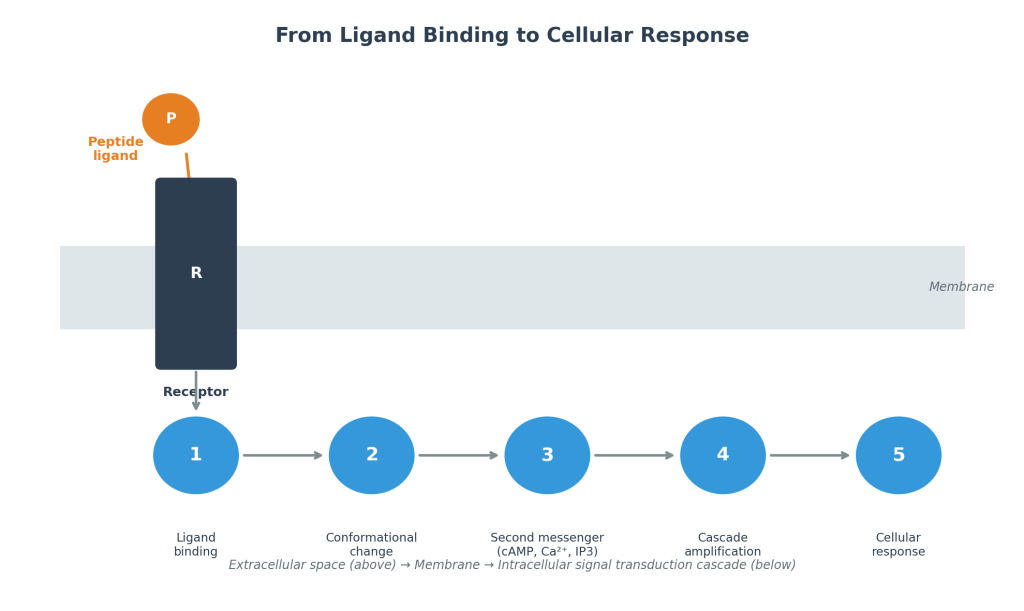
Receptor binding on its own doesn’t do anything — it’s the chain reaction that follows which produces a measurable biological effect. This chain is called a signal transduction pathway. For GPCRs specifically, ligand binding triggers a conformational change that catalyses GDP-GTP exchange on an associated heterotrimeric G protein, which is the formal starting point of the intracellular cascade<cite index=”5-1″>.</cite>
A simplified version of the pathway looks like this:
- Ligand binding — the peptide binds its receptor
- Conformational change — the receptor’s shape shifts, activating it
- Second messenger activation — internal signalling molecules (such as cAMP, calcium ions, or IP3) are released or activated
- Cascade amplification — a small number of activated receptors can trigger a much larger downstream response through enzyme cascades (e.g., kinase cascades)
- Cellular response — gene expression changes, protein activity shifts, or a physical cellular process (secretion, division, migration) occurs
This amplification step is one reason peptides can be biologically active at very low concentrations — a single binding event can be magnified many times over inside the cell. Signal attenuation follows a similarly defined sequence — receptor desensitisation, internalisation, and downregulation — which is why repeated-dose research designs need to account for receptor kinetics, not just ligand concentration<cite index=”5-1″>.</cite>
Agonists, Antagonists, and Modulators
Peptides used in research are generally studied as one of the following:
| Type | Behaviour at the Receptor | Typical Research Use |
|---|---|---|
| Agonist | Activates the receptor, mimicking or enhancing a natural signal | Studying downstream pathway activation |
| Antagonist | Binds without activating, blocking the natural ligand | Isolating a pathway by blocking it |
| Partial agonist | Produces a smaller effect than a full agonist even at maximal occupancy | Studying dose-response ceiling effects |
| Allosteric modulator | Binds a site other than the primary pocket, adjusting response to the natural ligand | Studying receptor regulation without direct activation |
Classifying a peptide correctly against this framework is usually one of the first steps in any receptor-pharmacology study.
How Long Do Peptides Take to Act? Understanding Onset in Research Models
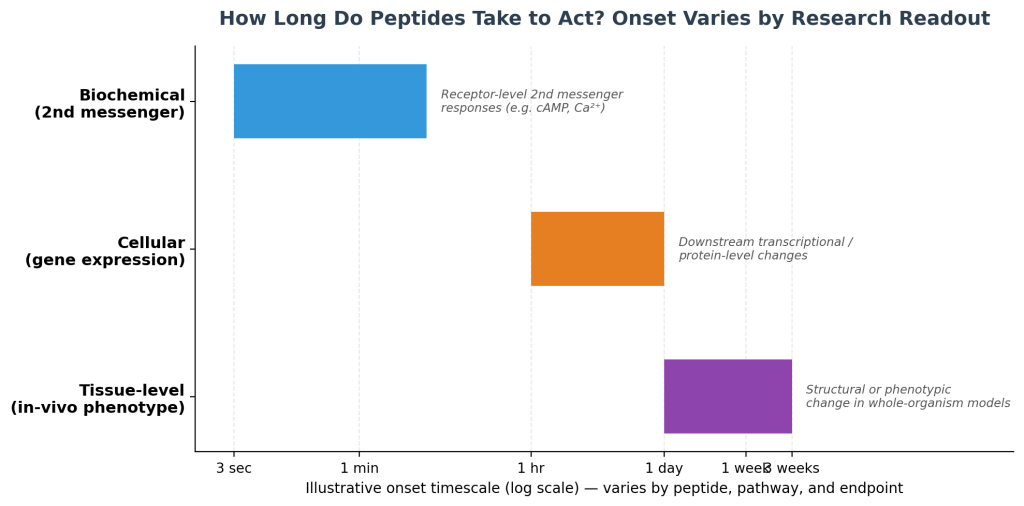
“How long do peptides take to work” is one of the most common questions in the field, and the honest answer is: it depends entirely on the pathway being studied, the administration route in the model, and what “effect” is being measured. There is no single onset time for “peptides” as a category. A few structural factors that research literature consistently points to:
- Receptor pathway type — a direct GPCR-mediated second-messenger response can register in seconds to minutes in an assay; a downstream transcriptional effect (gene expression change) may take hours; a structural or tissue-level change observed in an in-vivo model may take days to weeks of repeated dosing to become measurable
- Route modelled — orally administered peptides are largely degraded by gastrointestinal proteases before absorption, which is why injectable or topical routes are typically used in models requiring systemic bioavailability; topical peptides (e.g., in dermal research) act locally and are governed by skin penetration kinetics rather than systemic circulation
- Half-life of the specific peptide — this varies enormously by sequence, size, and whether the peptide has been modified (e.g., PEGylated or cyclised) for extended stability
- What’s being measured — a biochemical marker, a cell-based readout, and a whole-organism phenotypic outcome will naturally show effects on different timescales even for the same peptide
Because of this variability, “how long does it take for peptides to work” is not a question with a fixed answer across the literature — it needs to be scoped to the specific peptide, pathway, and endpoint in question.
Common Peptide Categories and Their Signalling Targets
| Category | Example Context | Primary Mechanism |
|---|---|---|
| Peptide hormones | Endogenous signalling peptides studied in metabolic and endocrine research | GPCR or RTK activation |
| Antimicrobial peptides | Innate-immunity research | Direct disruption of microbial membranes rather than classic receptor binding |
| Copper peptides (e.g., GHK-Cu) | Dermal and connective-tissue signalling research | Modulation of copper-dependent enzymatic activity and fibroblast signalling |
| Collagen-derived peptides | Nutritional and dermal research | Signalling peptides generated during collagen breakdown, studied for fibroblast stimulation |
Antimicrobial peptides are a useful contrast case: rather than binding a defined receptor pocket, many act by directly disrupting microbial cell membranes, which is a mechanistically distinct category from the receptor-mediated signalling described above.
Why Specificity Matters in Research Design
Because peptides tend to be highly selective for particular receptor subtypes, they’re frequently used as research tools to isolate a single pathway from the surrounding biological noise — something much harder to achieve with broader-acting small molecules<cite index=”4-1″>.</cite> This is a large part of why peptide-based probes are so valuable in mechanistic studies: they let researchers ask a specific question (“what happens if only this receptor is activated?”) with a level of precision that’s difficult to replicate otherwise. Structural biology work on peptide-binding GPCRs — including receptors such as GLP-1R and the μ-opioid receptor — has substantially advanced this precision by mapping exactly how specific peptide ligands trigger receptor activation<cite index=”4-1″>.</cite>
If you’re evaluating a specific compound’s regulatory status, see the legal and regulatory status section of our companion article.
FAQs
How do peptides work? Most peptides act as ligands that bind a specific receptor — commonly a GPCR — on or in a cell. That binding triggers a conformational change in the receptor, which activates an intracellular signalling cascade, ultimately producing a measurable cellular response.
How long do peptides take to work? There’s no universal figure. Direct receptor-level effects can occur within seconds to minutes in an assay; downstream transcriptional or tissue-level effects can take hours to weeks depending on the pathway, route modelled, and what endpoint is being measured.
How do collagen peptides work? Collagen peptides are short chains generated by breaking down collagen protein. In dermal and nutritional research, they’re studied for their potential to signal fibroblasts and influence connective-tissue turnover, distinct from the receptor-agonist mechanisms of hormone peptides.
How do copper peptides (GHK-Cu) work? Copper peptides such as GHK-Cu are studied for their role in modulating copper-dependent enzymatic activity in skin and connective tissue, an area of active dermal-signalling research rather than classical GPCR pharmacology.
How do peptide hormones work? Peptide hormones typically act as endogenous ligands for GPCRs or receptor tyrosine kinases, triggering the same ligand-binding → conformational change → signal transduction sequence described above.
How do antimicrobial peptides work? Rather than binding a specific receptor pocket, most antimicrobial peptides act by directly disrupting the membranes of target microorganisms — a mechanistically distinct pathway from classical receptor-mediated peptide signalling.
How do peptides work for skin research? In cosmetic-science and dermal research, certain peptide sequences are studied for their interaction with fibroblast signalling pathways relevant to collagen synthesis and skin-barrier function — a separate research category from injectable systemic peptides.
What’s the difference between how peptide injections and oral peptides work, pharmacologically? Orally ingested peptides are largely broken down by gastrointestinal proteases before they can be absorbed intact, which is why research models requiring systemic bioavailability typically use injectable or other parenteral routes instead. This is a pharmacokinetic explanation, not administration guidance.
What are peptides, and how do they work — in one sentence? Peptides are short amino-acid chains that typically work by binding a specific cellular receptor and triggering a defined signalling cascade, rather than acting as a blunt, non-specific compound.
Where can I read more about peptide structure and classification? See our companion article, What Are Peptides?, which covers peptide chemistry, size classification, and UK regulatory status in detail.
Next in this series: Types of Research Peptides, which breaks the field down into the major functional categories researchers work with.
Part of the Peptide Research UK guide.
External reference: StatPearls — Biochemistry, G Protein Coupled Receptors, NCBI Bookshelf