
Retatrutide vs Tirzepatide: What You Need to Know Before Comparing Them
Two names dominate current discussion of next-generation weight-management drugs: tirzepatide, an approved and prescribed medicine, and retatrutide, an investigational compound still completing Phase 3 trials. They’re frequently searched together because they work on overlapping biology — but they are not interchangeable, and as of July 2026 only one of them can legally be prescribed to a patient.
This article is educational and reflects publicly reported clinical trial data as of July 2026. It is not medical advice, and it does not cover sourcing, pricing, or dosing of unapproved products. Speak to a registered healthcare provider for anything related to prescribing or treatment decisions.
Table of Contents
- What Is Tirzepatide?
- What Is Retatrutide?
- Mechanism of Action Compared: Dual vs Triple Agonist
- Weight Loss Results: Retatrutide vs Tirzepatide
- Blood Sugar and Type 2 Diabetes Management
- Side Effects and Safety Profile
- Regulatory and Availability Status
- Pros and Cons
- Who Discusses Which Option With a Doctor
- Expert and Research Community Perspective
- FAQs
- Final Verdict
What Is Tirzepatide?
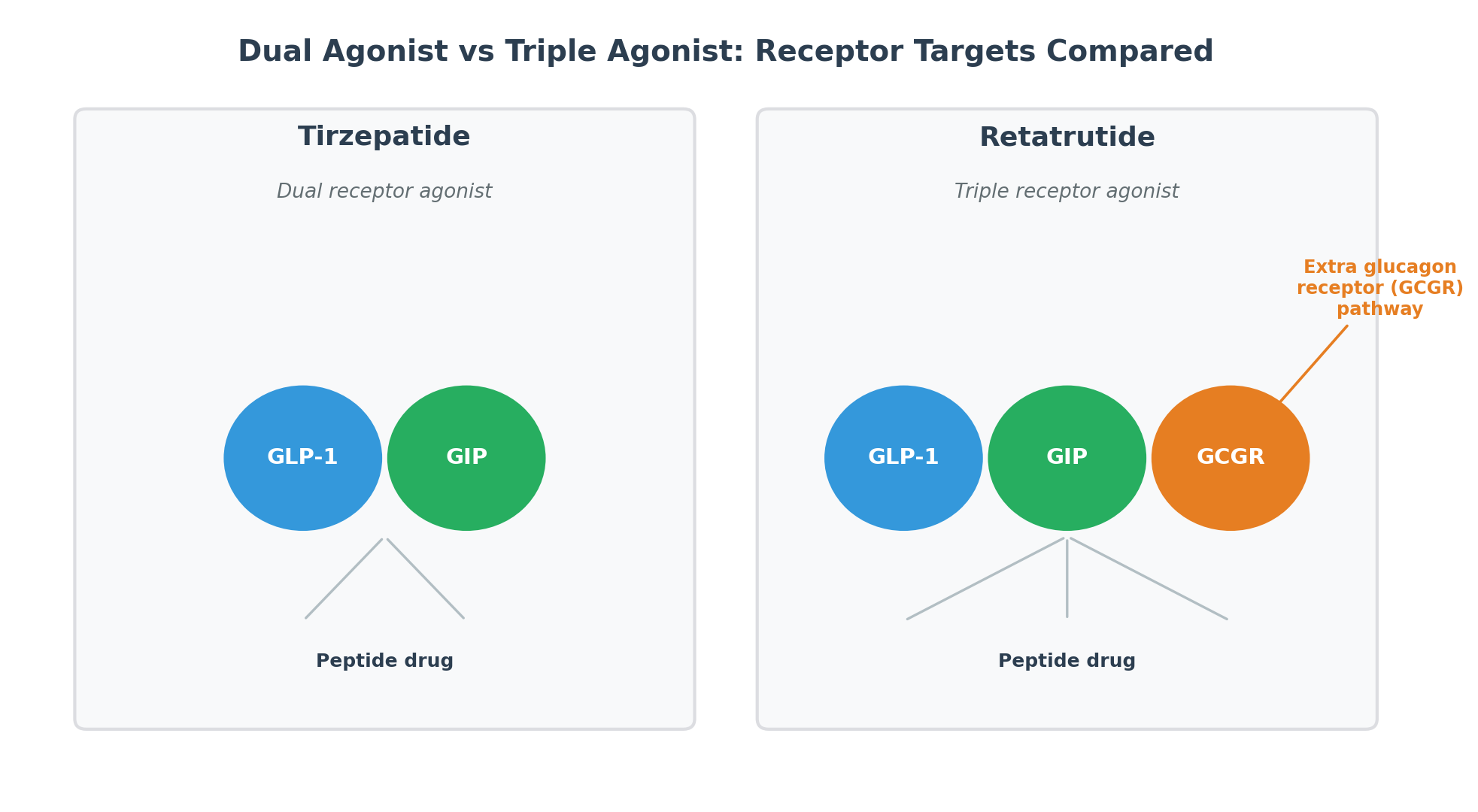
Tirzepatide is a synthetic peptide that acts as a dual agonis it activates both the GLP-1 (glucagon-like peptide-1) and GIP (glucose-dependent insulinotropic polypeptide) receptors. For background on how peptide ligands trigger receptor activity in general, see our companion explainer on how peptides work, which covers the same GPCR signal-transduction logic that underpins this whole drug class.
Tirzepatide is manufactured by Eli Lilly and is FDA-approved and MHRA-authorised under two brand names depending on indication: Mounjaro (type 2 diabetes) and Zepbound (chronic weight management). It was originally developed to improve glycaemic control in type 2 diabetes, with weight loss identified as a major secondary benefit that led to its separate obesity indication.
What Is Retatrutide?
Retatrutide (development code LY3437943) is often described as “what is reta” in shorthand searches — it’s a triple agonist, activating GLP-1, GIP, and glucagon receptors simultaneously, the third pathway being what distinguishes it from tirzepatide<cite index=”16-1″>.</cite> It’s developed by Eli Lilly and is the compound most researchers mean when they refer to “retatrutide peptide” in a clinical-trial context.
As of July 2026, retatrutide remains an investigational molecule available only to participants in Lilly’s clinical trial programme; it has not been approved by any regulatory agency, and no product claiming to be retatrutide is legitimate outside that trial setting<cite index=”14-1″>.</cite> The pivotal TRIUMPH-1 Phase 3 trial released its topline results in May 2026, studying adults with obesity or overweight and at least one weight-related condition<cite index=”14-1″>.</cite>
Mechanism of Action Compared: Dual vs Triple Agonist
| Feature | Tirzepatide | Retatrutide |
|---|---|---|
| Receptor targets | GLP-1, GIP (dual agonist) | GLP-1, GIP, glucagon (triple agonist) |
| Developer | Eli Lilly | Eli Lilly |
| Regulatory status | FDA/MHRA approved | Phase 3, not approved anywhere |
| Brand names | Mounjaro, Zepbound | None (investigational) |
| Administration studied | Subcutaneous injection | Subcutaneous injection |
The extra glucagon receptor pathway in retatrutide is mechanistically significant: glucagon receptor activation increases energy expenditure, which is a different mode of action from the appetite-suppression and insulin-sensitising effects that GLP-1/GIP dual agonism produces alone. This is the biological reason researchers have described retatrutide’s early trial results as unusually potent compared with dual-agonist and single-agonist predecessors.
Weight Loss Results: Retatrutide vs Tirzepatide
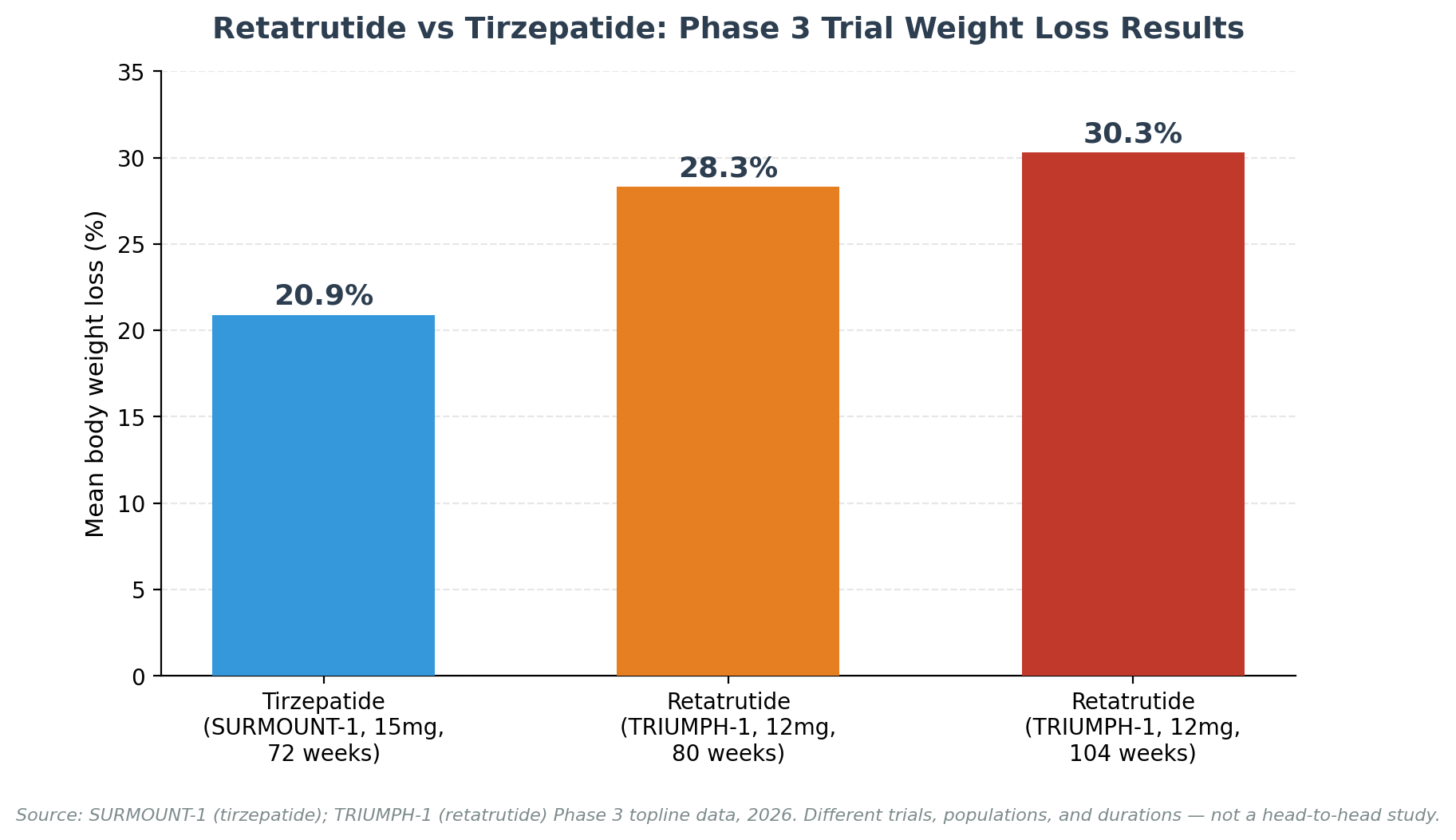
Trial design differs between the two drugs (different populations, durations, and dose arms), so figures should be read as directional rather than a head-to-head trial — there is no published study putting both drugs in the same trial arm.
| Trial | Drug | Dose | Duration | Mean Weight Loss |
|---|---|---|---|---|
| SURMOUNT-1 | Tirzepatide | 15 mg | 72 weeks | ~20.9% |
| TRIUMPH-1 | Retatrutide | 12 mg | 80 weeks | 28.3%, up to 30.3% at 104 weeks<cite index=”18-1″>.</cite> |
In the TRIUMPH-1 trial specifically, participants on the 12 mg dose lost an average of 70.3 lbs — 28.3% of body weight — over 80 weeks, with nearly half of participants achieving 30% or greater weight loss, a magnitude of result more typically associated with bariatric surgery<cite index=”15-1″>.</cite> These results were presented at the American Diabetes Association’s 2026 annual meeting<cite index=”14-1″>.</cite>
How Fast Does Each Drug Work?
Both drugs are titrated gradually over weeks to reach target dose, and meaningful weight loss in trial data accumulates progressively over months rather than appearing immediately the headline percentages above are measured at 72–104 weeks, not at treatment onset. Early metabolic and appetite effects are typically reported by trial participants within the first few weeks of reaching an effective dose, but the full body-composition effect builds over the full trial duration.
Blood Sugar and Type 2 Diabetes Management
Tirzepatide is already an approved treatment for type 2 diabetes under the Mounjaro brand, with a well-established glycaemic-control evidence base. Retatrutide’s diabetes-specific data is newer: the TRANSCEND-T2D-1 Phase 3 trial, the first completed Phase 3 programme in type 2 diabetes for retatrutide, reported HbA1c reductions of up to 2.0 percentage points alongside 16.8% weight loss across 537 patients<cite index=”19-1″>.</cite>
Side Effects and Safety Profile
Both drugs belong to the same broad GLP-1-based class and share a similar side-effect signature, though trial-reported rates differ by dose and drug.
| Side Effect Category | Tirzepatide (reported in trials) | Retatrutide (TRIUMPH-1 data) |
|---|---|---|
| Gastrointestinal (nausea, GI upset) | Common, dose-dependent | Common, dose-dependent |
| Discontinuation due to side effects | Dose-dependent | 4.1% (4 mg), 6.9% (9 mg), 11.3% (12 mg), vs 4.9% placebo<cite index=”15-1″>.</cite> |
| Dysesthesia (nerve tingling) | Reported at low rates | Up to 12.5% on the 12 mg dose<cite index=”18-1″>.</cite> |
| Urinary tract infection signal | Not a standout signal | Noted in TRIUMPH-1 data<cite index=”18-1″>.</cite> |
Most minor side effects reported in the retatrutide trials, such as urinary tract infections and mild nerve tingling, were reported as typically resolving without participants stopping treatment<cite index=”15-1″>.</cite> This safety data comes exclusively from supervised clinical trial settings with regular monitoring — it does not extend to any unsupervised or non-trial use of the compound, which is illegal and carries unknown risk regardless of trial safety data<cite index=”15-1″>.</cite>
Is Retatrutide Safe?
The honest answer is that retatrutide’s safety profile is well-characterised only within the clinical trial population it has been studied in so far. Trial-reported discontinuation and side-effect rates are informative, but “safe” in a regulatory sense requires full FDA/MHRA review of the complete Phase 3 dataset, which has not yet happened. Any product sold outside the trial programme has not been through this safety review at all, regardless of what it claims to contain.
Is Retatrutide a Steroid?
No. Retatrutide is a synthetic peptide hormone-receptor agonist, structurally and mechanistically unrelated to anabolic or corticosteroids. It works via the GLP-1/GIP/glucagon receptor pathways described above, not via androgen or corticosteroid receptor pathways.
Regulatory and Availability Status
This section is factual and reflects the formal regulatory position as of July 2026 — it is not a purchasing guide.
- Tirzepatide is an approved medicine (Mounjaro, Zepbound) available only via prescription through a registered healthcare provider and pharmacy in the UK and US.
- Retatrutide has no FDA, MHRA, or EMA approval, and no NDA (New Drug Application) has yet been filed — industry tracking currently expects a Q4 2026 filing at the earliest, with commercial availability, if approved, not expected before late 2027 or 2028<cite index=”20-1″>.</cite>
- Retatrutide is accessible only as a participant in an active clinical trial, which can be located through ClinicalTrials.gov, the official public registry of trials run under FDA and international oversight.
- Any product marketed online as “retatrutide,” including so-called research-use pens or vials, has not undergone regulatory review and is not verified to contain what it claims — Lilly’s own guidance is explicit that no legitimate retatrutide product exists outside its trial programme<cite index=”14-1″>.</cite>
For broader context on how the UK treats unlicensed peptide compounds generally, see our regulatory status overview in the companion “What Are Peptides?” article.
Pros and Cons
| Tirzepatide | Retatrutide | |
|---|---|---|
| Advantages | Approved, prescribable, established safety monitoring, insurance/NHS pathways exist | Larger trial-reported weight loss magnitude; additional glucagon-pathway mechanism |
| Limitations | Lower weight-loss ceiling than retatrutide’s early data; GI side effects | Not approved anywhere; no independently verified non-trial safety data; discontinuation rate rises with dose |
Who Discusses Which Option With a Doctor
- Tirzepatide is the option a doctor can actually prescribe today, for either type 2 diabetes management (Mounjaro) or chronic weight management (Zepbound), following standard clinical assessment.
- Retatrutide is not currently an option a doctor can prescribe outside enrolling a patient in an eligible clinical trial. Patients interested in retatrutide can ask their doctor about trial eligibility or search the public registry directly rather than seeking it through any commercial channel.
Expert and Research Community Perspective
Coverage of the TRIUMPH-1 results in the endocrinology and metabolic research community has focused on the magnitude of weight loss relative to bariatric surgery outcomes, with researchers noting this Phase 3 readout as a meaningful step toward eventual FDA approval rather than a finished result<cite index=”16-1″>.</cite> The TRIUMPH programme itself was designed as a registrational set of trials spanning obesity, obstructive sleep apnoea, and knee osteoarthritis under a shared master protocol, reflecting how broadly researchers are studying retatrutide’s potential indications beyond weight loss alone.
Two further Phase 3 readouts — TRIUMPH-2 and TRIUMPH-3 — remain outstanding as of mid-2026 and are expected to add to the evidence base ahead of any regulatory filing.
FAQs
What is retatrutide? Retatrutide is an investigational injectable peptide developed by Eli Lilly that activates three metabolic hormone receptors (GLP-1, GIP, and glucagon) simultaneously. It is not yet approved by any regulator and is only available through clinical trials.
What does retatrutide do? In trial settings, it has been shown to reduce appetite, improve blood sugar control, and produce substantial body weight reduction, with the added glucagon-receptor pathway associated with increased energy expenditure compared with dual-agonist drugs.
Does retatrutide burn fat? Trial data shows substantial reductions in body weight and body fat in the TRIUMPH-1 population, though “burn fat” in a mechanistic sense reflects the combined effects of appetite suppression, improved insulin sensitivity, and glucagon-receptor-driven energy expenditure, rather than a single isolated fat-burning action.
Is retatrutide stronger than tirzepatide? Based on separate trial populations, retatrutide’s TRIUMPH-1 results (28.3% mean weight loss at 80 weeks) numerically exceed tirzepatide’s SURMOUNT-1 results (~20.9% at 72 weeks). However, since the two drugs haven’t been tested head-to-head in the same trial, this comparison is directional rather than definitive.
When will retatrutide be FDA approved? No NDA has been filed as of July 2026. Industry tracking estimates a Q4 2026 filing, with a realistic approval window of late 2027 to Q1 2028 if trials continue to succeed<cite index=”20-1″>.</cite>
Can you switch from tirzepatide to retatrutide? Since retatrutide isn’t approved or prescribable outside a clinical trial, there’s no current clinical pathway to switch a patient from tirzepatide to retatrutide except by enrolling in an eligible trial — this is a decision to raise with a prescribing doctor, not something to arrange independently.
Is retatrutide safe long-term? Long-term safety data beyond the current 80–104 week trial windows doesn’t yet exist, because the drug hasn’t been in supervised use long enough to generate it. This is one of the specific things regulatory review is designed to assess before approval.
Are there natural alternatives to retatrutide or tirzepatide? No naturally occurring compound replicates simultaneous GLP-1/GIP/glucagon receptor agonism at the level these engineered peptides achieve; lifestyle, dietary, and other approved medical interventions work through different, generally less potent, mechanisms and should be discussed with a doctor based on individual circumstances.
How long does retatrutide take to work? In trial data, meaningful weight loss builds progressively across the full dosing period rather than appearing immediately — the headline results reported above are measured at 80 and 104 weeks of continued treatment under medical supervision.
Final Verdict
Tirzepatide is the real, prescribable option today, with an established regulatory pathway, monitored safety profile, and NHS/insurance routes to access it through a doctor. Retatrutide’s Phase 3 data is genuinely striking — the largest average weight loss yet reported for this drug class — but it remains investigational, with no approval, no legitimate commercial product, and safety data limited to supervised trial settings. The responsible comparison, as of July 2026, is: one is a treatment decision to make with your doctor now; the other is a trial-enrolment or watch-this-space question for later.