
Complete Retatrutide Research Guide
Introduction
Few compounds in metabolic research have generated as much attention as retatrutide. Developed by Eli Lilly, it is the first triple hormone receptor agonist to reach late-stage clinical trials, targeting three separate metabolic pathways in a single molecule. Where earlier generations of research compounds worked on one or two receptors, retatrutide’s combined GLP-1, GIP and glucagon receptor activity has produced some of the largest body-weight reductions yet recorded in a randomised controlled trial setting.
This guide brings together what the published and topline trial data currently show: how retatrutide is believed to work, what the clinical research programme has found so far, how it compares mechanistically and in reported outcomes to tirzepatide and semaglutide, and where the evidence base still has gaps. It is intended as a research reference, not a usage guide.
Retatrutide Mechanism
What is retatrutide?
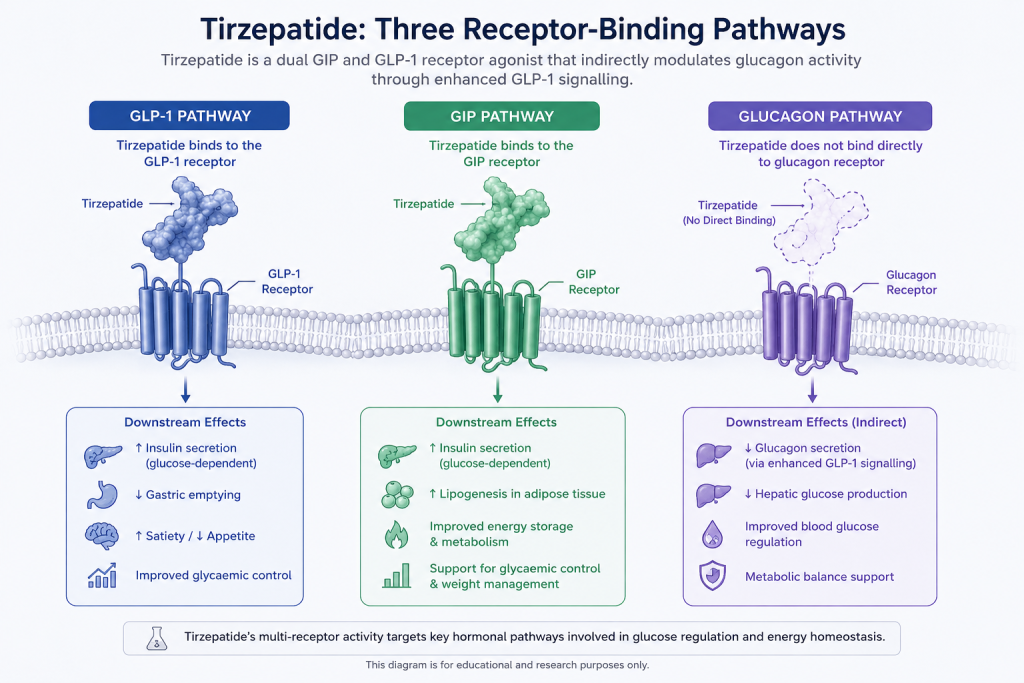
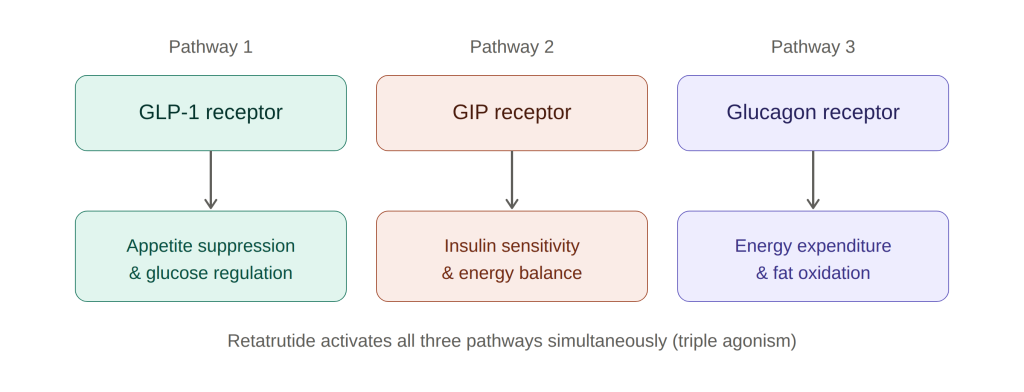
Retatrutide (Eli Lilly’s development code LY3437943) is a synthetic peptide classified as a triple hormone receptor agonist. It is designed to activate three separate receptors involved in energy metabolism and appetite regulation: the glucagon-like peptide-1 (GLP-1) receptor, the glucose-dependent insulinotropic polypeptide (GIP) receptor, and the glucagon receptor. This distinguishes it from single-target compounds such as semaglutide (GLP-1 only) and dual-target compounds such as tirzepatide (GLP-1 and GIP).
As of mid-2026, retatrutide remains an investigational compound. It has not received approval from the MHRA, FDA or EMA for any indication, and all current human exposure to the compound occurs within registered clinical trials.
GLP-1, GIP and glucagon receptor activity
Each of the three receptors retatrutide targets plays a distinct role in metabolism:
- GLP-1 receptor activity slows gastric emptying, increases satiety signalling, and enhances glucose-dependent insulin secretion — the same mechanism underlying semaglutide.
- GIP receptor activity is believed to improve insulin sensitivity and may amplify the effects of GLP-1 agonism on food intake and energy expenditure — the mechanism shared with tirzepatide.
- Glucagon receptor activity is the differentiating feature of retatrutide. Glucagon receptor agonism increases energy expenditure and hepatic fat oxidation, which researchers believe contributes to retatrutide’s pronounced effects on liver fat and its larger weight-loss signal relative to dual-agonist compounds.
How the triple-agonist mechanism is studied
Retatrutide’s mechanism has been characterised across the standard drug-development pipeline: receptor-binding assays and animal models established target engagement and pharmacokinetics, before progressing into human trials. The compound’s first human data came from two Phase 1 studies — a single-ascending-dose study in healthy participants, and a Phase 1b multiple-ascending-dose study in people with type 2 diabetes, published in The Lancet in 2022. These early trials established that retatrutide’s pharmacokinetic profile supports once-weekly dosing and characterised its initial safety and tolerability signals ahead of larger efficacy trials.
Metabolic and body-weight research findings tied to mechanism
The rationale for triple agonism is that stacking three complementary mechanisms — appetite suppression, insulin sensitisation, and increased energy expenditure — produces a larger combined metabolic effect than any single pathway alone. A Phase 2a liver sub-study, published in Nature Medicine in 2024, reported that <cite index=”3-1″>the 12 mg dose reduced liver fat by 86%, with the large majority of participants achieving substantial fat reduction</cite> — among the largest liver-fat reductions reported for any pharmacological intervention to date. Researchers attribute this specifically to the added glucagon receptor activity, which is not present in dual or single-agonist compounds.
Retatrutide Research Findings
Key clinical trials overview
Retatrutide’s research programme has progressed through Phase 1, Phase 2, and — as of 2026 — an active Phase 3 programme under Eli Lilly’s “TRIUMPH” trial umbrella. Following earlier Phase 2 obesity and type 2 diabetes trials, Lilly has confirmed <cite index=”3-1″>seven additional Phase 3 readouts are expected before the end of 2026</cite>, covering obesity, type 2 diabetes, metabolic dysfunction-associated steatotic liver disease (MASLD), chronic low back pain, and maintenance-dosing strategies.
Two pivotal Phase 3 readouts have been reported so far:
- TRIUMPH-4 (topline results, December 2025): a 68-week randomised, double-blind, placebo-controlled trial in adults with obesity or overweight and knee osteoarthritis. <cite index=”3-1″>Both the 9 mg and 12 mg weekly doses met all primary and key secondary endpoints</cite>.
- TRIUMPH-1 (topline results, May 2026): an 80-week trial in 2,339 participants with obesity or overweight and at least one weight-related comorbidity, testing 4 mg, 9 mg and 12 mg doses against placebo.
Weight-management research outcomes
The TRIUMPH-1 topline data, announced 21 May 2026, reported dose-dependent weight reductions at 80 weeks: <cite index=”5-1″>participants on 4mg lost an average of 17.6% of body weight, compared with 23.7% on 9mg, 25.0% on 12mg and 3.9% on placebo</cite>. In a further extension, <cite index=”5-1″>participants with a baseline BMI of 35 or higher who tolerated their assigned dose were escalated to the maximum tolerated dose for an additional 24 weeks</cite>, a design intended to test whether higher-dose maintenance produces further weight reduction.
In the earlier TRIUMPH-4 trial, participants with obesity and knee osteoarthritis on the 12 mg dose <cite index=”3-1″>lost an average of 28.7% of body weight (approximately 32.3 kg) at 68 weeks</cite>. That same trial reported meaningful secondary findings beyond weight: <cite index=”6-1″>WOMAC pain scores fell by more than four points from a baseline of six, a roughly 76% improvement</cite>, and <cite index=”6-1″>more than one in eight retatrutide-treated participants reported complete freedom from knee pain at week 68, compared with 4.2% on placebo</cite>.
[link to: Retatrutide Weight-Loss Trial Data Explained]
Type 2 diabetes findings
The TRANSCEND-T2D-1 trial, a 40-week Phase 3 study in adults with type 2 diabetes inadequately controlled by diet and exercise, reported that retatrutide <cite index=”8-1″>met the primary and all key secondary endpoints, delivering A1C reductions of up to 2.0% and average weight loss of up to 16.8% on the 12 mg dose</cite>. These results build on earlier Phase 2 findings in people with type 2 diabetes and support continued investigation of retatrutide as a glycaemic research compound, alongside its weight-management signal.
Safety and tolerability research
Across the TRIUMPH-1 trial, discontinuation due to adverse events was dose-dependent: <cite index=”7-1″>4.1%, 6.9% and 11.3% for the 4 mg, 9 mg and 12 mg doses respectively, compared with 4.9% on placebo</cite>. Reported adverse events have followed a pattern broadly consistent with other incretin-based compounds — predominantly gastrointestinal in nature — alongside <cite index=”7-1″>generally mild-to-moderate events of dysesthesia and urinary tract infection, most of which resolved during treatment</cite>. Cardiometabolic secondary measures in TRIUMPH-4, including non-HDL cholesterol, triglycerides and systolic blood pressure, were also reported to improve.
Current research limitations
Despite the scale of the TRIUMPH programme, several limitations remain relevant to how the current evidence should be interpreted:
- Most Phase 3 data available at the time of writing are topline announcements, not yet full peer-reviewed publications — detailed methodology and complete safety datasets typically follow months later.
- Long-term data (multi-year use, post-discontinuation weight regain, durability of liver and cardiometabolic benefits) remains limited.
- Trial populations to date have been drawn primarily from registered clinical trial sites; broader population diversity and real-world data are not yet available, since the compound has no approved indication.
- Head-to-head trial data against tirzepatide is not yet published; comparative figures currently rely on cross-trial comparisons, which carry inherent methodological limitations.
Comparison Articles
Retatrutide vs Tirzepatide
| Feature | Retatrutide | Tirzepatide |
|---|---|---|
| Receptor targets | GLP-1, GIP, glucagon (triple agonist) | GLP-1, GIP (dual agonist) |
| Regulatory status | Investigational; Phase 3 | Approved (Mounjaro, Zepbound) |
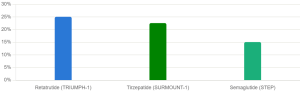
| Reported weight loss (matched-duration trials) | <cite index=”9-1″>28.7% at 68 weeks (TRIUMPH-4)</cite> | approximately 22.5% at 72 weeks (SURMOUNT-1) |
| Distinguishing research signal | Pronounced liver fat and LDL cholesterol effects, osteoarthritis pain reduction in TRIUMPH-4 | Established long-term safety and real-world data |
| Reported tolerability | <cite index=”9-1″>Qualitatively similar GI-adverse-event profile to tirzepatide and semaglutide</cite> | Well-characterised across years of post-approval use |
Researchers note that <cite index=”9-1″>direct head-to-head Phase 3 data comparing the two compounds does not yet exist</cite>, with a dedicated active-comparator trial among the studies still to report.
Retatrutide vs Semaglutide
| Feature | Retatrutide | Semaglutide |
|---|---|---|
| Receptor targets | GLP-1, GIP, glucagon | GLP-1 only |
| Regulatory status | Investigational; Phase 3 | Approved (Ozempic, Wegovy) |
| Reported weight loss (matched-duration trials) | 25.0% at 80 weeks (12 mg, TRIUMPH-1) | approximately 15% at 68 weeks (STEP trials) |
| Mechanistic differentiator | Additional GIP and glucagon receptor activity | Single-receptor, most extensively studied incretin mechanism |
| Evidence maturity | Emerging Phase 3 dataset | Multi-year real-world and long-term outcome data available |
Retatrutide vs other research compounds
Retatrutide sits within a broader landscape of incretin-based and multi-agonist research compounds under investigation, including other early-stage GIP/GLP-1/glucagon combinations and oral GLP-1 candidates such as orforglipron. Compared with this wider field, retatrutide is currently the most advanced triple-receptor agonist in late-stage trials, giving it the most substantial published dataset among non-approved multi-agonist candidates.
[link to: Research Peptide Comparison Guide 2026]
Frequently Asked Questions
What is retatrutide research?
Retatrutide research refers to the ongoing scientific investigation of a triple hormone receptor agonist compound targeting GLP-1, GIP and glucagon receptors, conducted through Eli Lilly’s clinical trial programme, including the Phase 3 TRIUMPH studies.
How does retatrutide work?
Retatrutide is designed to activate three metabolic receptors simultaneously: GLP-1 (appetite and glucose regulation), GIP (insulin sensitivity), and glucagon (energy expenditure and hepatic fat metabolism). Researchers believe this combination produces a larger combined metabolic effect than single or dual-receptor compounds.
Is retatrutide approved?
No. As of mid-2026, retatrutide is not approved for any indication by the MHRA, FDA or EMA. It remains an investigational compound under active Phase 3 clinical trial evaluation.
What do studies show?
Published and topline Phase 2 and Phase 3 data report substantial dose-dependent weight reduction, meaningful improvements in glycaemic control in people with type 2 diabetes, marked liver fat reduction, and secondary benefits including reduced osteoarthritis pain and improved cardiometabolic markers. A full peer-reviewed dataset for the most recent Phase 3 trials is still emerging.
Is retatrutide safe?
Safety data reported so far show a tolerability profile broadly consistent with other incretin-based compounds, dominated by gastrointestinal adverse events, with dose-dependent discontinuation rates. Long-term safety data beyond the current trial durations is not yet available, and safety in real-world, non-trial populations has not been established.
What is the future of retatrutide research?
Eli Lilly has indicated up to seven further Phase 3 readouts are expected across obesity, type 2 diabetes, liver disease (MASLD), chronic low back pain and maintenance-dosing studies before the end of 2026. Full peer-reviewed publication of the TRIUMPH-1 and TRANSCEND-T2D-1 datasets, along with regulatory submissions, are anticipated to follow as the programme matures.
Conclusion
Retatrutide represents one of the most closely watched developments in metabolic pharmacology research, with its triple-receptor mechanism producing some of the largest weight-loss and liver-fat findings reported in this drug class to date. The Phase 3 TRIUMPH programme has moved the evidence base substantially beyond earlier Phase 2 data in 2026 alone, though full peer-reviewed publication, long-term safety data, and head-to-head comparative trials are still pending.
This guide reflects the current state of published and topline research and is provided for educational purposes only. Retatrutide is not approved for clinical use, and this article should not be interpreted as guidance on acquisition, dosing, or administration. Readers wishing to track the research as it develops can follow ongoing trial registrations and results at ClinicalTrials.gov and in peer-reviewed journals such as The Lancet, Nature Medicine and the New England Journal of Medicine
External sources referenced: Eli Lilly TRIUMPH-1 and TRIUMPH-4 topline trial announcements (PRNewswire, May 2026 and December 2025); The Pharmaceutical Journal coverage of TRIUMPH-1 results (May 2026); Nature Medicine, Harrison et al., 2024 liver sub-study


