
Peptide Research verification
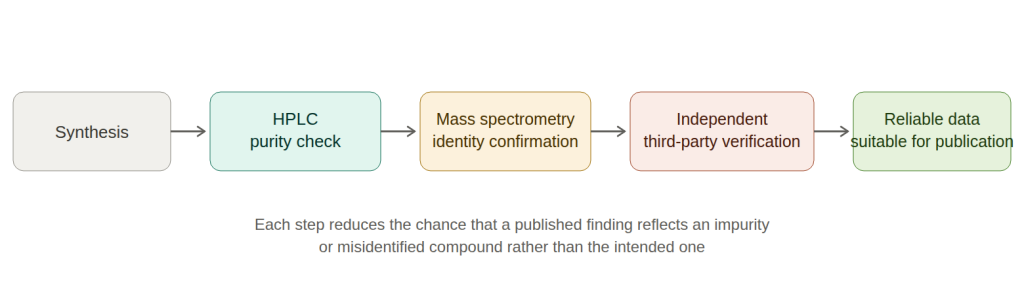
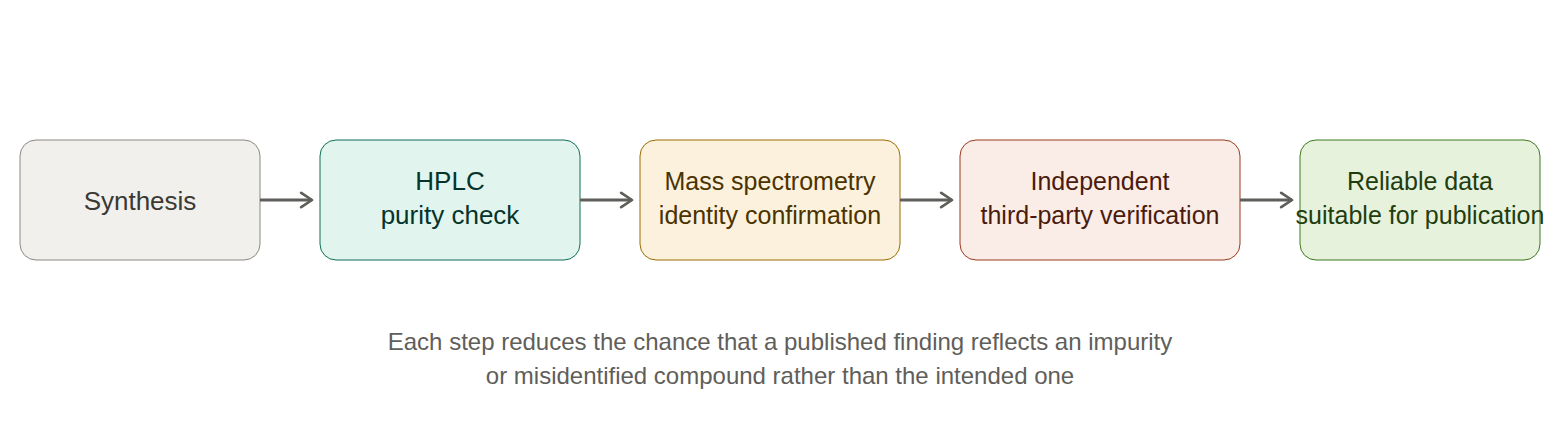
When a study reports a finding about a peptide compound, that result is only as reliable as the material that was actually tested. If a batch used in a trial is impure, misidentified, or inconsistent between production runs, the resulting data becomes difficult to interpret — and difficult for other researchers to replicate. This is why peptide research verification (purity testing, identity confirmation, and independent quality checks) sits quietly behind almost every piece of published research, even though it rarely makes it into the headline findings.
Through peptide research verification methods such as High-Performance Liquid Chromatography (HPLC), mass spectrometry, and Certificates of Analysis (COAs), researchers can assess whether a peptide matches its intended structure and meets the quality standards required for meaningful scientific investigation. These analytical tools help establish confidence in experimental materials and improve the reliability and reproducibility of research outcomes.
This guide explains what these verification methods actually measure, how to read the documentation researchers rely on, and why the distinction between manufacturer-reported and independently verified data matters when you’re evaluating how much confidence to place in a study. For readers looking to understand how verification standards apply in practice, our Complete Retatrutide Research Guide provides a detailed overview of the compound’s research background, mechanisms, and current scientific evidence.
Understanding Analytical Verification in Research
What HPLC measures, and why it matters
High-performance liquid chromatography (HPLC) separates a sample into its individual components, allowing researchers to measure what percentage of a sample is the intended compound versus impurities, degradation products, or synthesis by-products. In published research, a stated purity percentage (e.g. “>98%”) is typically an HPLC-derived figure.
Why this matters for interpreting data: if the material used in a preclinical or early-phase study wasn’t well-characterised, an observed effect could be partly or wholly attributable to an impurity rather than the compound itself — a genuine confound that responsible researchers control for.
Mass spectrometry and identity confirmation
While HPLC establishes purity, mass spectrometry confirms identity — that the molecule present actually matches the expected molecular weight and structure. The two methods are complementary: a sample can show a clean, single peak on HPLC and still be the wrong compound if identity hasn’t been separately confirmed.
Why this matters beyond the lab
For a reader evaluating a study, these details rarely appear beyond a single line in the methods section — but their absence is itself informative. A paper that doesn’t specify how the test compound was characterised gives you less basis for confidence in its results than one that does.
Reading a Certificate of Analysis (COA)
What a COA actually reports
A Certificate of Analysis is a document summarising the analytical tests run on a specific batch of material. In a research context, a COA commonly includes:
| Field | What it tells you |
|---|---|
| Purity (HPLC) | Percentage of the sample that is the target compound |
| Identity confirmation | Method used (typically mass spectrometry) to confirm the correct molecule |
| Batch/lot number | Allows a specific production run to be traced and referenced |
| Testing date | When the analysis was performed — relevant because compounds can degrade over time |
| Testing laboratory | Whether the test was run in-house or by an independent third party |
The limitation worth knowing
A COA is only as trustworthy as the party that generated it. A certificate produced by the same organisation supplying the material carries an inherent conflict of interest — it’s self-reported data, not independently verified data. This distinction is directly analogous to the funding-source question raised in evaluating any clinical study: who ran the test matters as much as what the test found.
For this reason, experienced researchers look beyond the headline purity figure and consider who performed the analysis, whether independent verification was used, and whether the documentation provides sufficient detail to assess the results critically. Understanding these factors is an important part of interpreting peptide research verification data responsibly.
To explore more educational resources on evaluating research quality, analytical testing methods, and peptide science, visit Research Guides and Education.
Third-Party vs Manufacturer Testing
Why independent verification changes the evidentiary weight
Independent, third-party laboratory testing removes the conflict of interest inherent in self-reported figures. This is the same principle underlying independent data monitoring committees in clinical trials — a separate party checking the data is less likely to (even unintentionally) report favourably.
What to look for when a study or source cites testing
- Was testing conducted by the manufacturer, or an accredited independent laboratory?
- Is the underlying chromatography data available, or only a summary percentage?
- Is the testing batch-specific, or a general claim applied across all production?
A source that only ever states “independently tested” without naming the laboratory or showing underlying data offers considerably less verifiability than one that discloses both.
How Compound Quality Affects Research Validity
Batch variability and reproducibility
One of the recurring challenges in early-phase research is batch-to-batch variability — differences in purity or identity between production runs that can make results difficult to replicate across studies, even when the protocol is identical. This is part of why regulated clinical trials use pharmaceutical-grade material manufactured under Good Manufacturing Practice (GMP) conditions, which impose far stricter and more consistent quality controls than typical research-grade material.
Why “research-grade” and “pharmaceutical-grade” are not the same evidentiary standard
Material used in a formally registered Phase 2 or Phase 3 clinical trial is manufactured and tested under regulatory oversight, with documentation and traceability requirements that go well beyond a standard COA. When reading comparisons between early lab findings and later formal trial results, this distinction is one reason results don’t always carry over cleanly from one context to the other.
Frequently Asked Questions about Peptide research verification
What does an HPLC purity percentage actually tell you?
It indicates what proportion of a tested sample, by the chromatography method used, consists of the target compound rather than impurities or by-products. It does not, on its own, confirm the molecule’s identity — that requires a separate method such as mass spectrometry.
Is a manufacturer’s COA reliable on its own?
It provides useful information but carries an inherent conflict of interest, since the same party supplying the material generated the test. Independent, third-party verification is considered a stronger evidentiary standard.
Why do clinical trials use different material standards than early research?
Registered clinical trials use pharmaceutical-grade material manufactured under Good Manufacturing Practice conditions, which involve stricter, more consistent quality controls and documentation than typical research-grade characterisation.
Does purity testing appear in published papers?
Often only briefly, in the methods section. Its absence or vagueness is itself a signal worth noting when assessing how much weight to give a study’s findings.
Conclusion
Analytical verification rarely makes headlines, but it’s part of the evidentiary foundation that determines whether a research finding can be trusted and reproduced. Understanding what HPLC and mass spectrometry actually measure, how to read a Certificate of Analysis critically, and why independent testing carries more evidentiary weight than self-reported data, gives readers another concrete tool for judging the strength of a study — alongside trial phase, sample size, and peer-review status
External sources: